admin
admin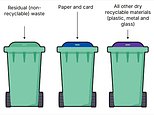
Taxpayers face paying millions of pounds to fund Labour’s plan to give households four bins to separate waste after councils were told to ‘simplify’ recycling practices.
The Government has told local authorities across England to provide residents with four containers under controversial changes being enforced from March 31 this year.
But the changes – which will also see weekly food waste collections brought in – are costing millions of pounds, with one council facing a £21million bill, another forking out £2.1million on 15 new vans and a third spending £350,000 just to change bin lids.
The quartet of containers will be a non-recyclable waste bin; a food and green waste container; a bin or bag for paper and cardboard; and a bin for other recyclables.
The receptacles may be bins, bags or stackable boxes – but critics have voiced fears that more bins on the street could block pavements for parents pushing prams.
Others said some areas will have to wait for more than a decade for new food waste collections because pre-existing contracts with waste firms prevent any changes.
Councils are being allowed to miss the deadline, leading critics to accuse them of being permitted to put their commercial interests before environmental targets.
Ministers are bringing in the change in an attempt to eradicate a ‘postcode lottery’ on bin collections, which causes confusion as different councils have varying policies.
Under existing legislation, some households have to separate their waste into seven bins – meaning they could benefit from a reduction in the number of containers.
Current laws introduced in 2021 defined recycling as glass, plastic, food waste, paper and card, resulting in some authorities issuing individual bins for each.
The fresh legislation will come into place for residential households from the end of March, having been enforced for business recyclable waste since that date last year.
The four new bins for households in England
The new default requirement for most households in England from March 31 this year will be four containers for:
- residual (non-recyclable) waste
- food waste (mixed with garden waste if appropriate)
- paper and card
- all other dry recyclable materials (plastic, metal and glass)
These container types may include bags, bins or stackable boxes.
The new guidance also means all waste authorities should provide weekly food waste collections from households to allow people to dispose of this more frequently.
But Benjamin Elks, grassroots development manager at the TaxPayers’ Alliance, told the Daily Mail: ‘Local taxpayers will be furious if their hard-earned cash is thrown away on costly new bins.
‘Waste collections have been a mess for years and simplifying the system is welcome, but attaching a huge price tag is a rubbish idea.
‘Local authorities must keep costs down, not dump yet another bill on residents.’
Legal expert and self-proclaimed ‘binfluencer’ Gary Rycroft told BBC Morning Live: ‘This is a big thing that’s happening and local councils in England are starting to deal with it and people are starting to get new bins.
‘In fact in Lancaster I’ve seen them out on the streets. It’s causing a bit of a hazard in my view – because, people with prams… you’ve got these big new bins there on the pavement.’
He also addressed concerns that those not following the policy could face a £400 fine, but said this penalty had ‘always been there’ and covered rules about ‘not overfilling your bin in case seagulls come and take the waste away’ and ‘not keeping it on the pavement for too long’.
Mr Rycroft added: ‘Always check with your local council, that’s the key thing to do – your local council have their own rules. If you’re not sure what to do, check with the council and check when you’re going to get your new bins, if you’ve not got them already.’
The method for the rollout varies between councils, with East Suffolk giving people a new wheelie bin or container, so they can separate paper and card from plastics, metal, cartons and glass bottles.
Legal expert and self-proclaimed ‘binfluencer’ Gary Rycroft told BBC Morning Live that the bins in Lancaster were ‘causing a bit of a hazard’ to people walking along the pavement with prams
The authority approved spending £350,000 last October to change its green garden bin lids to avoid confusion with the new containers for paper and card.
The council claimed at the time that this was value for money, because replacing bins in their entirety would be £875,000 plus distribution, taking the total to over £1million.
In Northumberland, Councillor John Riddle told a council cabinet meeting last November of the changes: ‘It isn’t going to be cheap – it’s going to cost us around £21million to do it.
‘Running costs will be covered by Extended Producer Responsibility but let’s not beat about the bush – this will be an additional cost that you pay as a consumer that goes into recycling.’
Extended Producer Responsibility sees producers made responsible for the costs of disposing or recycling their products and packaging after they have been used and thrown away – in an effort to encourage them to reduce waste.
The City of Wolverhampton Council is set to spend £1.3million on ten new food waste collection vehicles to join its fleet of bin lorries because of the new requirement for weekly food waste collections.
North Tyneside Council said £2.1million had been budgeted for the purchase of 15 new food waste vans and home receptacles in preparing for its own service.
Meanwhile other people in North East England could be waiting for 13 years for new food waste collections due to existing council contracts with waste collection firms.
People living in South Tyneside, Sunderland and Gateshead will not have food bins collected separately until 2039, while residents of Cumbria must wait until 2034.
Nicky Gynn, a Green Party councillor for South Tyneside Council, told the BBC she was ‘totally devastated’ by the delay for people in her area, adding that changes to the contract would have cost the council ‘tens of millions of pounds’.
Helen Davison, a councillor from the same party on Cumberland Council, added that she was ‘really frustrated’ by the wait for residents in the region, where a 25-year waste contract was in place.
A spokesman for the the Department for Environment, Food and Rural Affairs told the Daily Mail: ‘From March, every household in England will receive weekly food waste collections and will have the same materials collected for recycling.
‘Local authorities will continue to deliver services in a way that works best for their area, but these reforms will end the postcode lottery of bin collections and help keep our streets cleaner.’
And a Local Government Association spokesperson told the Daily Mail today: ‘Councils want to recycle as much as they can and support the Government’s ambition for weekly food waste collections from April 2026.
‘It is important that all councils have local flexibility on how this service is delivered, alongside adequate funding and support.
‘In particular, councils need clarity on the level of revenue funding from 2026 so they can plan new services. We are also asking government to commit to reviewing service costs after a year, to help plug any costs gaps that have emerged.’
And a statement from the National Association of Waste Disposal Officers said: ‘The Environmental Protection Act 1990, as revised by the Environment Act 2021, requires local authorities to collect for recycling a core set of materials from households, including food waste, garden waste, and a range of packaging.
‘The legislation requires materials like paper, metal, glass and plastic to be collected separately from one another, unless it is not technically or economically practicable to do so, or if there is no environmental benefit in doing so.
‘It is down to each relevant local authority to assess the practicability and environmental of these separate collections based on local circumstances.’
Local authorities can issue a notice to householders setting out how waste should be presented for collection, such as what containers should be used and what days or times these should be presented for collection.
If a householder does not follow these provisions then a fixed penalty notice can be issued – but the council must follow a Government code of practice before doing so.
The penalty – which is a civil penalty in England, not a criminal one – is between £60 and £80.
However homeowners have also previously reported being issued with fines of up to £400 for putting the bins out on the wrong day – including one recent example in London’s Waltham Forest in October 2023.
When the four-bins policy was first announced in November 2024, then-environment secretary Steve Reed said communities had faced an ‘avalanche of rubbish’ in streets, rivers and seas due to the ‘Conservative fiasco’ that resulted in seven bins for some households.
He claimed Labour was ‘ending the Wild West’ and introducing a ‘streamlined approach to recycling to end to the postcode lottery, simplify bin collections and clean up our streets for good’.
The Government also said at the time that the four-bin policy was not expected to increase in future to ensure councils and other waste collectors ‘still have the flexibility to make the best choices to suit local need’.
Kerbside plastic film collections from businesses and relevant non-domestic premises and households are additionally set to be introduced by March 31 next year.
Household recycling rates in England have stagnated at 45 per cent since 2015, according to official data.
Households in the country dumped 5.6 million tonnes of packaging in 2023, according to analysis commissioned by the Local Government Association, County Councils Network and District Councils Network.
The report found that 3.2million tonnes of packaging were put into recycling bins, 2.3million tonnes were put into residual – or ‘black’ bins, and 70,000 tonnes were mistakenly put in with food waste.
A statement from Defra in November 2024 said: ‘We will make recycling easier: citizens will be able to recycle the same materials across England whether at home, work or school, and will no longer need to check what is accepted for recycling in their local area.
‘A universal standard will ensure that everything that can be collected for household recycling is collected in every region.
‘Simpler Recycling will also end the ‘postcode lottery’ of bin collections in England whereby councils collect different materials for recycling, causing confusion for households.
‘We will maintain flexibility for local authorities to deliver these changes in the most appropriate way for their area.’


 newspost