poster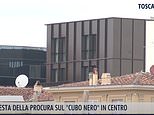
Florence police have launched a probe into how a new upmarket flat block nicknamed the ‘Black Cube’ was allowed to be built after locals slammed it as a ‘monstrosity’.
The black, burnished metal building sits in stark contrast to the warm, earthy yellows and oranges of the traditional Renaissance architecture that defines the Tuscan city – home to the 14th-century Palazzo Vecchio, the stunning Duomo, Giotto’s Bell Tower and countless other historic buildings.
It is so out of place that the police are now involved, questioning 12 people for irregularities in the permitting, planning and zoning process behind the looming high-rise’s creation.
Outrage over its imposing existence has torn through Florence, with even the city’s ancient nobility calling out to stop the ‘affront’ to the city’s skyline, while 72.8 per cent of people polled called for its demolition, local newspaper La Nazione found.
There are also fears that the city’s UNESCO World Heritage Site status could be stripped after it was granted in 1982.
‘It is totally ugly, totally out of context with Florence’s cityscape and may break rules on height,’ Eike Schmidt, an opposition councillor and former head of Florence’s Uffizi Gallery, previously told The Times.
Schmidt, who ran for mayor in 2024, added that he would be lodging a complaint to UNESCO.
‘We don’t want Florence to lose its status, but maybe UNESCO can put pressure on the city to change the building materials and lower the height of the block,’ he said.
The ‘Black Cube’ tall above the surrounding buildings and has been nicknamed a monstrosity
Officially called the Teatro Luxury Apartments, it stands within the UNESCO site, a stones throw from the US Consulate and the Santa Maria Novella train station
The Black Cube – officially called the Teatro Luxury Apartments – features a terrace, a spa, a sunroom, a gym and a restaurant.
It is built on the site of the old Teatro Comunale (Municipal Theatre) on Corso Italia, within the UNESCO heritage area, and is surrounded by 19th-century buildings.
Police are now investigating how the theatre was decommissioned and sold in 2013 under Matteo Renzi, who was then mayor of Florence before he became the Italian prime minister in 2014. They are questioning architects and councillors involved in the development.
Investigators are now aware that the Teatro Comunale passed through a state entity and was then sold to an Italian investment subsidiary, The Telegraph said.
From there, it was bought by property giants Blue Noble and Hines as part of a joint venture within the Future Living fund managed by London-based Savills.
Hines maintains the Black Cube was built with all the necessary permits.
The building’s dark and white colours are a ‘slap’ to the city’s coloured stone architecture, former city councillor Sergio Givone said.
Building regulations are so tight in the city that even changing the shade of window shutters in the Renaissance city is the subject of intense bureaucratic deliberation.
How the US developer has managed to build what locals refer to as The Monster of Corso Italia has raised more than a few eyebrows.
The nobility of the city have become embroiled in the controversy after being coaxed in over a elegant lunch laid on by architect Roberto Budini Gattai, nicknamed the Communist Nobleman.
16 noble families have all spoken out against the ‘afront’ to the Florentine skyline
The beautiful Renaissance city centre of Florence was granted UNESCO status in 1982 but there are fears the ‘Black Cube’ could affect this. Other sites have lost their status due to urban development like Liverpool in 2021 and Dresden in 2009
In a letter to the mayor, the 16 noble families said: ‘We must save Florence from any other ‘black cubes’. No more violence toward our city.’
Some of these noble families have lived in the city since the Medici era (1434 to 1737).
Among the signatories is French Princess and former Duchess of Aosta Claude Marie Agnès Cathérine d’Orléans, 82. She’s lived in Florence since 1964 after her marriage to Prince Amedeo of Savoy.
She spoke bluntly to the Corriere Fiorentino: ‘The Black Cube and the Social Hub on Viale Belfiore are monstrosities. I apologise to the architects who designed them, but that’s the way it is. I don’t understand why, when you do something new, you don’t try – I don’t mean copying – but perhaps taking inspiration from older buildings.’
Locals to the area like Jacopo Palorni, 37, believe ‘Its obviously not for Florentines’, with many long-standing residents being forced to move out of the historic city centre to more affordable housing on the outskirts.


 admin
admin
 newspost