poster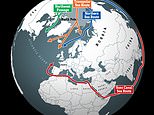
By SHANNON MCGUIGAN, NEWS REPORTER
Published: | Updated:
Putin is amassing nuclear weapons and attack submarines in the Arctic Circle as his country prepares for war with NATO, Norway has said.
Norway’s Defence Minister Tore Sandvik claimed his country had found Russia had been increasing its military presence in the Arctic, particularly in the Kola peninsula.
The politician also said Vladimir Putin had been attempting to take over the Arctic region where its fleet is based to block shipping routes to Nato allies if war broke out.
‘Russia is building up on the Kola peninsula… where one of the largest arsenals of nuclear warheads in the world is located,’ Mr Sandvik told The Telegraph.
‘They [the nuclear weapons] are not only pointed towards Norway, but towards the UK and over the pole towards Canada and the US.
‘We are the eyes and ears of Nato in this area, and we see that they’re testing new weapons, for example hypersonic missiles, and they are testing nuclear-driven torpedoes and nuclear warheads.’
The Kola peninsula, famed for accommodating the world’s most condensed nuclear weapon stockpile, plays a key role in the Kremlin’s ability to deliver a ‘second strike’.
The term ‘second strike’ refers to a nation’s ability to retaliate following an initial nuclear strike by a rival.
A Mikoyan MiG-29KUB carrier-based multirole trainer aircraft of the Russian Northern Fleet’s naval aviation lands at the Severomorsk-3 airfield in the Arctic Circle
The Kola Peninsula, historically home to the Russian Northern Fleet, was previously established in 1733 to safeguard the Russian Empire’s fisheries and trade routes.
However, today, according to Mr Sandvik, the area has a more menacing purpose.
According to the politician, even though Putin has suffered significant losses in Ukraine, with one million soldiers lost, his fleet remains intact and is still being developed.
Over the last two years, Russia has launched a new frigate and a multi-role submarine.
Mr Sandvik noted that the most dangerous aspect of Russia today is its submarines.
Although the Kremlin may be struggling in the Ukraine war, its nuclear warheads and ‘second-strike’ capacity allow it to maintain its superpower status.
Prior to latest developments, the Russian fleet included at least 16 nuclear-powered submarines and the advanced Tsirkon hypersonic missile – capable of traveling at speeds up to eight times the speed of sound.
The distance from a northwestern European port to the Far East along the Northeast Sea Route is almost 40% shorter than the traditional route via the Suez Canal. Other sea routes are becoming more accessible for more of the year
The US Army’s 1st Brigade, 11th Airborne, operates out of Fort Wainwright, Alaska
Mr Sandvik highlighted the importance of monitoring the fleet, claiming it to be ‘the most important surveillance in NATO.’
However, as ice caps in the region melt, it allows for new shipping routes to open, which would be financially fruitful for ships travelling between Europe and Asia.
But, in Oslo, officials say there would be fierce competition over control of two strategically important shipping routes in the Arctic, as these potential channels would be key supply lines in a conflict with Russia.
The first crucial route is the Bear Gap, a narrow stretch of water that lies between mainland Norway and the island of Svalbard, which Russian vessels must travel through to access the Atlantic Ocean.
The second is the GIUK Gap, a strategic passageway situated between Greenland, Iceland, and the United Kingdom, which prove to be vital for naval forces in the area.
‘Putin is not interested in peace…Putin’s plan is not a stable peace with Ukraine. If he can, he will come back,’ Mr Sandvik told The Telegraph.
‘Even if we have a peace deal in Ukraine, with boots on the ground and a stable situation, one analysis is that he will mobilise millions of soldiers up close to the border with Finland.’

 newspost