admin
admin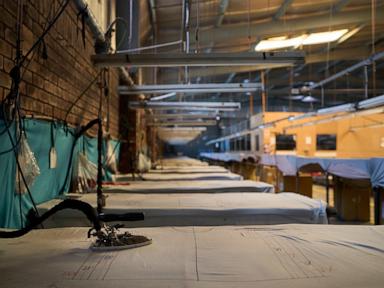
MASERU, Lesotho — The deafening roar of hundreds of sewing machines has gone silent. Spools of thread in every color are covered in dust. The warehouse is dark and empty.
In the tiny African nation of Lesotho, clothing manufacturer Tzicc’s business has dried up in the face of tariffs imposed by U.S. President Donald Trump’s administration. A few months ago, work was steady. The factory’s 1,300 employees have made and exported sportswear to American stores, including JCPenney, Walmart and Costco.
But when Trump announced sweeping new tariffs on nearly all U.S. trading partners in April, Lesotho found itself topping the list, with a rate of 50% — higher even than that of China, where the economy is 8,000 times larger. Officials here and economic experts said they were baffled.
Since then, Trump backed off — temporarily. During a monthslong pause for trade talks, the U.S. has charged a baseline 10% tariff and announced new rates for dozens of countries starting Friday. Lesotho’s rate will be set at Trump’s whim, with aides suggesting that tariffs charged on goods from smaller African countries could top 10%.
Many nations have received letters laying out a new tariff. With the pause set to expire Friday, Lesotho officials say they’ve not received one and they find themselves among the countries where Trump says officials simply don’t have time for one-on-one negotiations. Leaders — and the 12,000 people employed by garment factories exporting to the U.S. market — are still waiting.
The damage has already rippled through Lesotho’s economy, where textile manufacturing comprises the largest private industry with more than 30,000 workers in 2024.
For Tzicc and its customers, the threat and apparent singling out of Lesotho were enough. Management decided to rush to deliver preexisting orders before tariffs resumed. But American buyers stopped placing new orders. With no work left, virtually all the factory’s employees were sent home — potentially permanently.
“Well, unfortunately, we finished,” factory compliance manager Rahila Omar said, pointing out the irony of the strategy as she walked among rows of silenced and covered machines. “That is why now we don’t have any work.”
Omar is one of a handful of employees left in the eerily quiet factory. A few remain in the accounting department; others empty leftover stock to a warehouse elsewhere.
Officials and workers fear this may be a sign of what’s to come for other factories in Lesotho, where poverty is widespread among the population of 2 million and most textile workers single-handedly support their families.
In March, a month before slapping Lesotho with the 50% tariff, Trump described it as a place “nobody has ever heard of,” struggling to pronounce the nation’s name in a speech criticizing U.S. foreign aid.
It’s true Lesotho is a “very minuscule economy,” as its own trade minister, Mokhethi Shelile, described it.
But its relationship with Washington dates back decades. The U.S. was the first country to open an embassy in the capital, Maseru, after Lesotho declared independence from the United Kingdom in 1966. The military received U.S. training, and hundreds of millions in U.S. funds were sent to Lesotho to fight the HIV/AIDS epidemic via the now defunctUSAID office and the PEPFAR program.
As textiles grew to become Lesotho’s main export, some 75% of its product went to the U.S. Lesotho became known as Africa’s denim capital. If an American purchased jeans from a U.S. brand such as Wrangler or Levi’s, they may have been “Made in Lesotho,” as tags still note.
In 2000, the U.S. signed the African Growth and Opportunity Act, allowing Lesotho and other African nations to export goods to the U.S. duty free.
Shelile said he was in the process of negotiating AGOA’s September renewal when he was awakened in the middle of the night by texts from aides bearing news of the 50% U.S. tariffs.
“No, this cannot be real,” Shelile remembers thinking. “What did we do to deserve this?”
According to the Trump administration, Lesotho charges a 99% tariff on U.S. goods. The government here said it doesn’t know how the U.S. calculated that.
In theory, the tariff decision was based on trade deficit: Lesotho’s exports to the U.S. were around $240 million last year — mainly clothing and diamonds — and imports from the U.S. were only $2.8 million. But in practice, the math is more complicated than that. And in reality, Lesotho simply cannot afford to import more U.S. products. Nearly half the population lives below the poverty line.
“The trade deficit that exists between Lesotho and the U.S. is a natural trade deficit that can happen when you have these types of disparities between two economies,” Shelile said. “It cannot be breached and certainly cannot be breached by imposing tariffs.”
Last year, Lesotho’s overall unemployment rate was about 30%, national data shows. For those 35 and younger, it was nearly 50%.
Popular Reads
The threat of tariffs has exacerbated the national unemployment troubles, prompting the government to declare a state of disaster this month.
“No matter how we slice it, we’ve already had a lot of losses,” Shelile said. “People have lost quite a lot money. And to claw back and come back to where we were before this is going to take time.”
Most of the 12,000 people hired by Lesotho’s 11 factories exporting to the U.S. are women with children to feed and school fees to pay.
Of those, 9,000 jobs are directly in the line of fire and an additional 40,000 will suffer indirectly from the U.S.-imposed tariffs, Shelile said.
“We’re talking people in real estate that are leasing some rooms,” he said. “We’re talking people in transport, whether it’s long-distance haulage to the port, or it is a taxi driver taking people to work in the morning. They are going be affected.”
Mapontso Mathunya used to work on Tzicc’s cutting room floor and is now unemployed. Her husband also is out of a steady job. With two young children, Mathunya was the family’s breadwinner. She now tries to sell snacks and cigarettes on the street but finds it a daily struggle to bring home even a few cents.
“Our financial burden has been heavy,” she said. “Things are bad.”
The future of the Tzicc factory depends on what happens Friday, compliance manager Omar said.
Owned by a Taiwanese national, the factory has been open since mid-1999. In a peak month, it made up to 1.5 million pieces of clothing for JCPenney.
Key U.S. customers for Tzicc — JCPenney, Walmart and Costco — did not reply to AP to comment.
Pivoting to the neighboring South African market, one of the solutions proposed by the trade minister and industry consultants, wouldn’t be enough to even cover the employees’ payroll, Omar said.
And even if American buyers return, it’s unlikely the factory could rehire all its 1,300 workers, she added.
Today, just a few blocks away, former employees try their luck looking for work at other factories that are still operating. Most are turned away.
“Life is difficult,” former worker Mathunya said. “There is nothing, nothing at all. People don’t have money.”
______
Pascalinah Kabi in Maseru, Josh Boak in Washington and Anne D’Innocenzio in New York contributed.
_______ For more on Africa and development: https://apnews.com/hub/africa-pulse
______
The Associated Press receives financial support for global health and development coverage in Africa from the Gates Foundation. The AP is solely responsible for all content. Find AP’s standards for working with philanthropies, a list of supporters and funded coverage areas at AP.org.


 poster
 newspost