newspost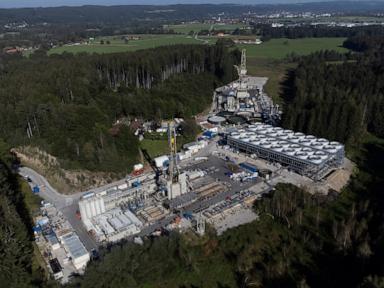
Residents in the German town of Geretsried have long wanted to run their buildings with clean heat and electricity from geothermal energy instead of fossil fuels.
Their hopes were dashed about 15 years ago when a drilling company couldn’t find enough hot water close to the surface to be profitable using traditional geothermal technology. That basically left them with natural gas.
“We gave up. We had big hopes,” recalled First Mayor of Geretsried Michael Müller, who was raised in the town.
Today the next generation of geothermal companies is trying to succeed where previous efforts failed. They don’t rely on hot water close to the surface, but instead use techniques developed in the oil and gas industry to drill deep and extract heat from dry, hot rock. One of them, Eavor, is starting up its first commercial power plant in Geretsried — turning the tiny town of about 26,000 people, south of Munich, into a proving ground for the future of geothermal energy.
Can technology like this be scaled and really make a difference for the future of the planet? The International Energy Agency thinks so. In a recent report, it said technology breakthroughs are unlocking huge potential for geothermal energy. Now that companies are drilling deeper than 3 kilometers (close to 2 miles), nearly every country has the potential to make heat and electricity this way, the IEA said.
“It has been a niche energy and concentrated in a few countries,” IEA Executive Director Fatih Birol said in an interview. But soon, Birol said, “geothermal can contribute to the global energy picture in an accelerated manner.”
Eavor CEO John Redfern said the earlier failure in Gerestried opened up the possibility for a high-profile success — Geretsried’s ordinary geology was appealing. No one would’ve been impressed if the Canadian company demonstrated its technology in Iceland, a place with abundant, easily accessible hot water, he added.
It helped that the town was excited for geothermal and open to new ideas, he added.
“Our whole point is that we want to have geothermal anywhere, everywhere,” Redfern said. “What better way to prove that than to put our first well where they tried and failed with traditional geothermal systems.”
Germany is committed to transitioning away from fossil fuels. As part of the commitment, heating systems must switch to renewable sources because heating is one of the main sources of carbon dioxide emissions in Germany. And Germany couldn’t depend on importing natural gas from Russia after Russia invaded Ukraine in 2022.
Eavor, named for the phrase “energy for ever,” has a demonstration facility in Alberta, Canada. Company executives know Geretsried well. One of them managed operations for the contractor that drilled there previously.
This project will start by generating electricity in Geretsried, then add heat as the town fully builds out a district heating system.
With district heating, heat is generated in a central location and distributed to homes and businesses. Most of these systems make their heat from burning fossil fuels, especially in China and Russia, which have the largest number of them, according to the IEA. Europe has 17,000 district heating and cooling networks, serving 67 million people, according to Euroheat & Power, the international network for district energy.
In the United States, district energy systems are most often on college campuses, at hospitals, on military bases and in some downtown areas in larger cities. Some universities are switching their district heating systems off gas or heating oil to geothermal energy to address climate change. The Trump administration, while pivoting back to pro-oil and gas policies, does appear to also favor geothermal.
Eavor has a contract to provide heat in the northwestern German city of Hanover, too. The city of more than 500,000 people is phasing out coal.
Eavor is also licensing its technology to utilities and companies that are trying to curb emissions and want secure energy, Redfern said. A large Japanese power provider, Chubu Electric Power Company, is a major investor in Eavor. Japan has many sites suitable for geothermal but few geothermal power plants.
The way it works is that Eavor drills two wells about 4 kilometers (2.5 miles) deep, then branches out and drills a dozen lateral wells, to maximize contact with the hot rock. The wells intersect to create a closed loop where water can flow, the “Eavor loop.” The Geretsried project will have four loops, each with two vertical wells and about 12 lateral ones.
Eavor does not frack, or hydraulically fracture, to create cracks and increase the permeability of rock.
Instead in Geretsried, it will pump water down to flow through the hot rock, heating up on contact. It will rise naturally to the surface through an outlet well.
That hot water can be used to heat the utility’s water so it can be sent through pipes to heat the equivalent of about 36,000 homes. The hot water also can be routed to a power plant to make steam and then recirculated. When used to spin a turbine, that steam can generate electricity without any planet-warming greenhouse gas emissions.
Müller, the mayor, said it’s better to start changing the approach to energy today than push it off to tomorrow. He said residents can’t rely on fossil fuels long term, they have to address climate change and they need secure energy.
“We want to remain future proof,” he said. “So let’s start the future.”
___
The Associated Press’ climate and environmental coverage receives financial support from multiple private foundations. AP is solely responsible for all content. Find AP’s standards for working with philanthropies, a list of supporters and funded coverage areas at AP.org.


 admin
admin
 poster